Comitative (Maps & Data)
Sara Zadykian, Chiara Naccarato
Last update: May 2022
See chapter
Plain text
Zadykian, Sara and Chiara Naccarato (2021). “Comitative (Maps & Data)”. In: Typological Atlas of the Languages of Daghestan (TALD), v 2.0.1. Ed. by George Moroz, Michael Daniel, Konstantin Filatov, Timur Maisak, Timofey Mukhin, Irina Politova, Elena Shvedova, Samira Verhees and Chiara Naccarato. Moscow: Linguistic Convergence Laboratory, HSE University. DOI: 10.5281/zenodo.6807070. https://lingconlab.ru/tald.
BibTeX
@incollection{zadykian2021,
  title = {Comitative (Maps & Data)},
  author = {Sara Zadykian and Chiara Naccarato},
  year = {2021},
  editor = {George Moroz and Michael Daniel and Konstantin Filatov and Timur Maisak and Timofey Mukhin and Irina Politova and Elena Shvedova and Samira Verhees and Chiara Naccarato},
  publisher = {Linguistic Convergence Laboratory, HSE University},
  address = {Moscow},
  booktitle = {Typological Atlas of the Languages of Daghestan (TALD), v 2.0.1},
  url = {https://lingconlab.ru/tald},
  doi = {10.5281/zenodo.6807070},
}
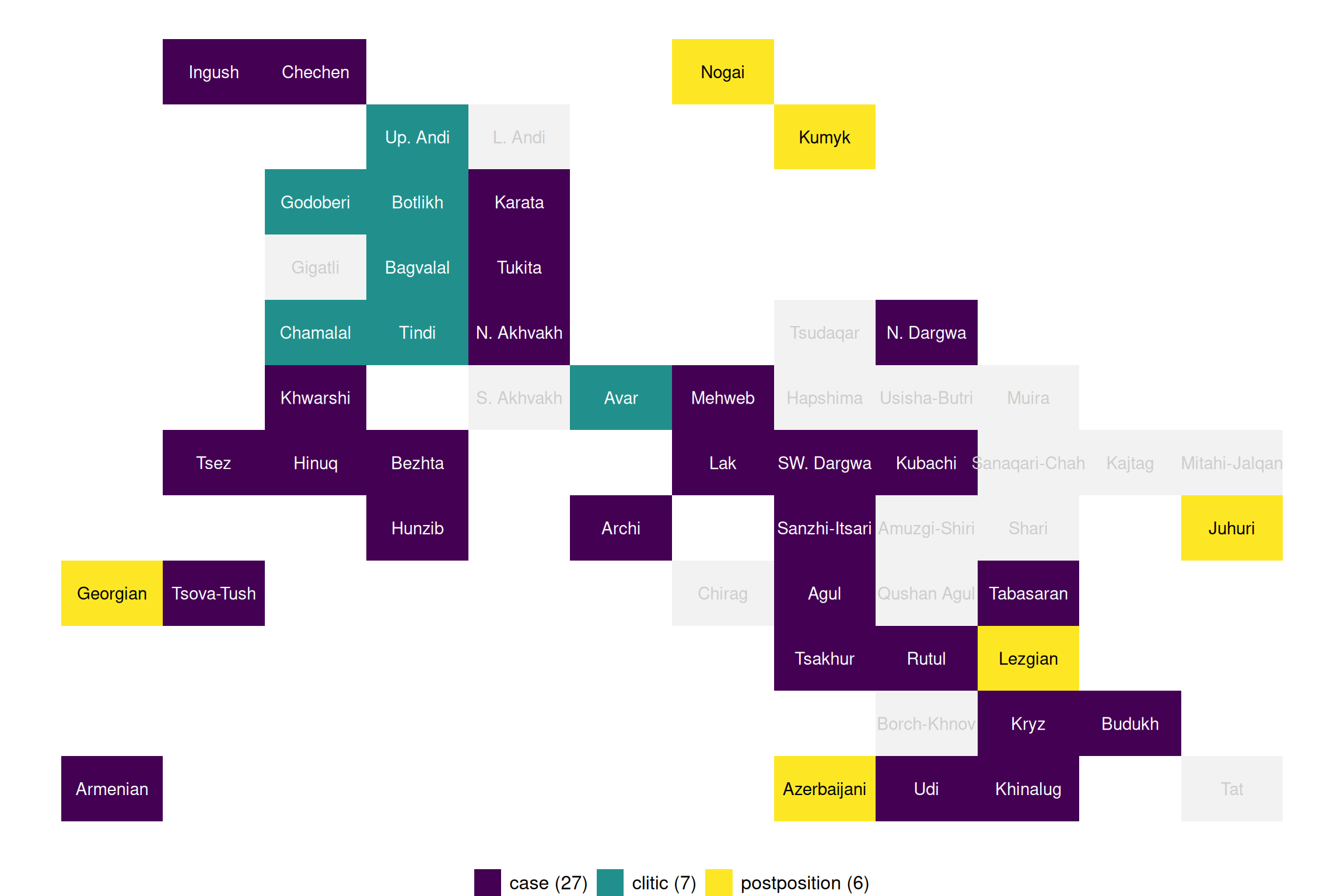
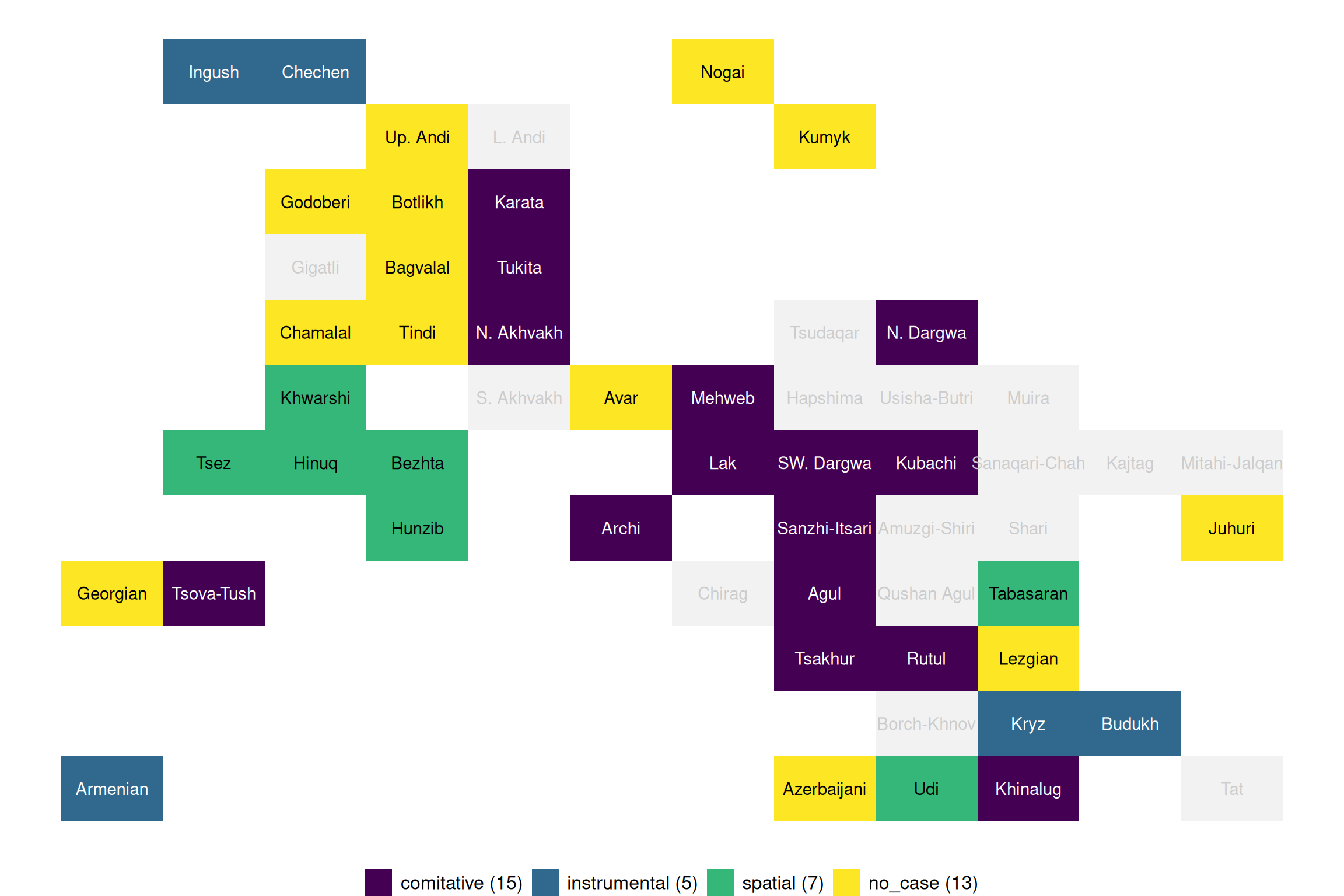
Visualization 1 (General datapoints) shows no more than one dot per language. Visualization 2 (Extrapolated data) represents each language as a cluster of dots, which correspond to villages where a certain language is spoken. Visualization 3 (Data granularity) takes into account dialect levels. Visualization 4 (Tile map) is analogous to Visualization 1 and displays languages as rectangles that are distributed according to their geographic location. On the Data granularity maps you can see the village and the data type (village data, general language data, etc.) when you click on a dot. Hover over or click on a dot to see the language. By unticking the box “show languages” you can remove the inner dots and visualize the distribution of different values in the area without the distraction of genealogical information.
3 Datatable
Download the whole dataset.
References
Abdullaev, Sajgid N. (1954). Grammatika darginskogo jazyka [Dargwa grammar]. Makhachkala: IJaLI.
Abdullaeva, Ajšat Z., Nurmagomed È. Gadžiaxmedov, Kalsyn S. Kadyradžiev, et al. (2014). Sovremennyj kumykskij jazyk [Contemporary Kumyk]. Makhachkala: IJaLI.
Alekseev, Mixail E., Boris M. Ataev, Magomed A. Magomedov, et al. (2012). Sovremennyj avarskij jazyk [Contemporary Avar language]. Makhachkala: Aleph.
Alexeyev, Mikhail and Samira Verhees Botlikh. Ed. by Yuri B. Koryakov, Timur A. Maisak and Steven Kaye. Berlin/New York.
Authier, Gilles (2009). Grammaire kryz. Paris: Peeters.
—–— (2012). Grammaire juhuri, ou judéo-tat, langue iranienne des Juifs du Caucase de l’est. Wiesbaden: Dr. Ludwig Reichert Verlag Wiesbaden.
Baskakov, Nikolaj A. (1940). Nogajskij jazyk i ego dialekty: grammatika, teksty i slovarʹ [Nogai and its dialects: grammar, texts and dictionary]. Moscow: Izdatelʹstvo Akademii nauk SSSR.
Berg, Helma van den (1995). A grammar of Hunzib. Munich: Lincom.
Bokarëv, Anatolij A. (1949). Očerk grammatiki čamalinskogo jazyka [Grammar sketch of Chamalal]. Moscow/Leningrad: Izdatelʹstvo Akademii nauk SSSR.
Bokarëv, Evgenij A. (1959). Cezskie (didojskie) jazyki Dagestana [Tsezic (Didoic) languages of Daghestan]. Moscow: Akademija.
Chechuro, Ilya (2019). “Nominal morphology of Mehweb”. In: The Mehweb language. Essays on phonology, morphology and syntax. Ed. by Michael Daniel, Nina Dobrushina and Dmitry Ganenkov. Berlin: Language Science Press, pp. 39-72.
Comrie, Bernard, Madzhid Khalilov, and Zaira Khalilova (2015). A grammar of Bezhta. Leipzig: Max Planck Institute for Evolutionary Anthropology.
Creissels, Denis (2020). A sketch of Northern Akhvakh. Ed. by Yuri Koryakov and Timur Maisak. Berlin/New York.
Daragan, Julija V. and Timur A. Maisak (2001). “Časticy, sojuzy i transkategorialʹnye pokazateli [Particles, conjunctions and transcategorical markers]”. In: Bagvalinskij jazyk. Grammatika, teksty, slovari [The Bagvalal language. Grammar, texts, dictionaries]. Ed. by Aleksandr E. Kibrik, Ekaterina A. Lyutikova and Sergei G. Tatevosov. Moscow: Nasledie, pp. 173-184.
Desheriev, Yunus D. (1953). Bacbijskij jazyk [Tsova-Tush language]. Moscow: Akademija.
—–— (1959). Grammatika xinalugskogo jazyka [Khinalug grammar]. Moscow: Akademija.
Dum-Tragut, Jasmine (2009). Armenian. Amsterdam/Philadelphia: John Benjamins.
Fedorova, Olga (1996). “Usage of nominal forms”. In: Godoberi. Ed. by Alexandr E. Kibrik, Sergei G. Tatevosov and Alexander Eulenberg. Munich/Newcastle: Lincom Europa, pp. 76-91.
Forker, Diana (2013). A grammar of Hinuq. Berlin/Boston: De Gruyter Mouton.
—–— (2020). A grammar of Sanzhi Dargwa. Berlin: Language Science Press.
Gadžieva, Marʹjam Z. (2007). “Fonetičeskie i morfologičeskie osobennosti tukitinskogo dialekta karatinskogo jazyka”.
Ganenkov, Dmitrij S. (2008). “Morfologičeskaja i semantičeskaja xarakteristika padežej udinskogo jazyka [Morphological and semantic characteristics of Udi]”. In: Udinskij sbornik: grammatika, leksika, istorija jazyka [Udi. Grammar. Lexicon. History of the language]. Ed. by Mixail E. Alekseev, Timur A. Maisak, Dmitrij S. Ganenkov and Yury A. Lander. Moscow: Akademija, pp. 11-53.
Haspelmath, Martin (1993). A grammar of Lezgian. Berlin/New York: Mouton de Gruyter.
Hewitt, George (1995). Georgian. A Structural Reference Grammar. Vol. 2. London: School of Oriental and African Studies, University of London.
Ibragimov, Garun X. (2004). Rutulʹskij jazyk [Rutul]. Makhachkala: Narody Dagestana.
Jakovlev, Nikolaj F. (1960). Morfologija čečenskogo jazyka [Chechen morphology]. Grozny: Izdatelʹstvo Akademii nauk SSSR.
Kaye, Stephen, Aleksandra Martynova, George Moroz, et al. (2020). A sketch of Andi (Zilo dialect). Ed. by Yuri Koryakov and Timur Maisak. Berlin/New York.
Kazenin, Konstantin I. (2013). Sintaksis sovremennogo lakskogo jazyka [Syntax of contemporary Lak]. Makhachkala: IJaLI.
Khalilova, Zaira (2009). “A grammar of Khwarshi”.
Magomedova, Patimat T. (2012). Tindinskij jazyk [Tindi]. Makhachkala: IJaLI.
Magometov, Aleksandr A. (1963). Kubačinskij jazyk [Kubachi]. Tbilisi: Akademija Nauk Gruzinskoj SSR.
Maisak, Timur A. (2014). Agulʹskie teksty 1900-1960-x godov. [Agul texts of the 1900-1960s]. Moscow: Academia.
Mikailov, Kazbek Š. (1967). Arčinskij jazyk [Archi]. Makhachkala: IJaLI.
Musaev, Magomed-Said M. (2002). Darginskij jazyk [The Dargwa language]. Moscow: Akademija.
Nichols, Johanna (2011). Ingush grammar. Berkeley/Los Angeles: University of California Press.
Pasquereau, Jérémy (2020). Karata. Ed. by Yuri Koryakov and Timur Maisak. Berlin/New York.
Širaliev, Mamedaga Š. and Ervand V. Sevortjan (1971). Grammatika azerbajdžanskogo jazyka (fonetika, morfologija, sintaksis) [Azerbaijani grammar (phonetics, morphology, syntax)]. Baku: Èlm.
Sosenskaja, Tatʹjana B. (1999). “Poslelog [Postposition]”. In: Èlementy caxurskogo jazyka v tipologičeskom osveščenii [Elements of the Tsakhur language in a typological perspective]. Ed. by Aleksandr E. Kibrik and Sergei G. Tatevosov. Moscow: Nasledie, pp. 121-129.
Sumbatova, Nina R. and Yury A. Lander (2014). Darginskij govor selenija Tanty: grammatičeskij očerk. Voprosy sintaksisa. Moscow: Jazyki slavjanskoj kulʹtury.
Sumbatova, Nina R. and Rasul O. Mutalov (2003). A Grammar of Icari Dargwa. Munich: Lincom Europa.
Talibov, Bukar B. (2007). Buduxskij jazyk [Budukh]. Moscow: Akademija.
Xanmagomedov, Bejdullax G-.K. and Kim T. Šalbuzov (2001). Tabasaransko-russkij slovarʹ [Tabasaran-Russian dictionary]. Moscow: Nauka.